
Canada's September job losses: what the public-private split means for your search
Employment fell by about 68,000 in Canada in September 2026. Understand the public-sector decline, the private-sector estimate, and what to check in your job search.
Published · Updated

The headline and the breakdown measure the same month
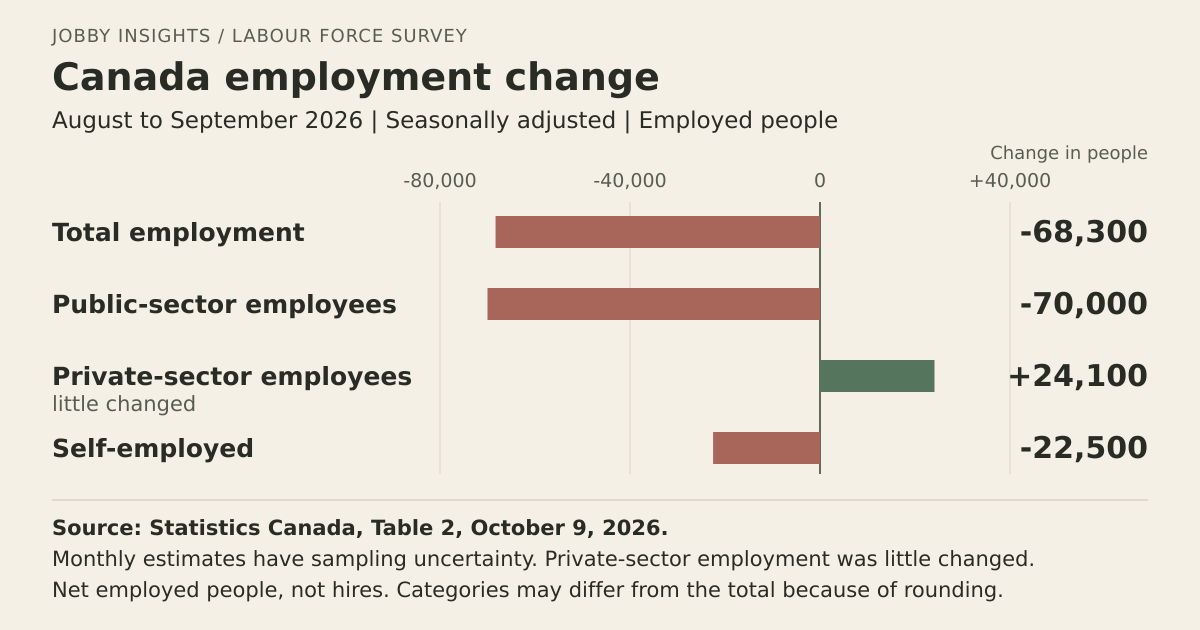
A Build Canada post on October 9 drew attention to the split behind Canada's September job losses. It said losses were dominated by public-sector work and self-employment, while private-sector employment rose by 24,100. That figure matches the published table. The important qualification is how Statistics Canada interprets the monthly change.[1][2][3]
Statistics Canada reported an employment decline of about 68,000 and an unemployment rate of 6.5%. Its detailed table shows 70,000 fewer public-sector employees, 22,500 fewer self-employed people and 24,100 more private-sector employees. Total employment fell by 68,300 in the table. Small differences when adding the categories reflect rounding. These are seasonally adjusted estimates of employed people. They are not counts of advertised vacancies or new hires.[2][3]
The private-sector estimate needs a clear qualification
Statistics Canada described private-sector employment as little changed for a second consecutive month. A positive estimate can appear in the table without establishing a clear monthly increase. The Labour Force Survey uses a household sample. Its release warns that monthly estimates have more sampling variability than trends measured over longer periods. Treating the 24,100 figure as proof of a private-sector hiring surge would overstate the evidence.[2][3]
The longer comparison gives more context. Private-sector employment was up by 163,000 from September 2025. Public-sector employment was down by about 119,000 over that period, with most of that decline attributable to educational services. Public-sector employment also fell for a fourth consecutive month. These national patterns still cannot identify which employers have suitable openings today.[2]
Public-sector employment and industry are different categories
The report groups people by class of worker, including public-sector employees, private-sector employees and the self-employed. It separately groups employment by industry, including education, health care and manufacturing. These are two views of the same workforce. Adding an industry's decline to the public-sector decline would mix overlapping categories and could double-count part of the change.[3]
Educational services employment fell by about 35,000 in September. Health care and social assistance fell by about 23,000. The release reports these as industry-wide changes, so they should not be presented as an exact breakdown of the 70,000 public-sector decline. The period matters too: despite its monthly decline, employment in health care and social assistance was up by 93,000 over the year.[2][3]
Your location can differ from the national result
September employment fell by 49,000 in Quebec and 20,000 in British Columbia. It rose by 23,000 in Alberta. Ontario employment edged down by 20,000, and its unemployment rate was little changed at 7.0%. A national headline can therefore describe a different situation from the province where you are searching.[2]
A smaller share of people unemployed in August found work in September than a year earlier. The job-finding rate was 30.6%, compared with 32.8% a year earlier. That rate measures the share of people unemployed in August who found work in September. It does not measure application success, interview conversion or your personal chance of an offer.[2]
Use the report to check your search assumptions
Our practical recommendation is to review the kinds of employers and locations in your search. If you mainly target public-sector work, check whether the specific organization is recruiting and whether each vacancy remains open. You can also consider private-sector roles that use your existing skills. The report does not show that moving sectors will improve your outcome.[2][3]
For each role, record the employer's current posting, duties, location, work arrangement, pay information and closing date when available. Compare the requirements with evidence from your actual experience. Keep the application truthful. These are editorial recommendations for evaluating individual roles. They are not tested results from the survey, which reports broad employment conditions.[2]
Our further recommendation is to review your own search records: suitable roles found, applications submitted, replies and interviews. If replies are scarce, inspect role fit and the clarity of your evidence before deciding to submit more applications. The lower national job-finding rate provides context. It cannot explain why a particular employer did not reply.[2]
What this release cannot tell you
The September survey reflects conditions during September 13 to 19, 2026. It was released on October 9. It does not provide a live inventory of jobs available on the publication date. Net employment changes also cannot be read as a layoff count: hiring, departures and other changes can occur within the same period.[2][3]
Public-sector employment explains much of September's national decline, while the private-sector monthly estimate was little changed. The report cannot identify which employers have a suitable vacancy for you today.[2][3]
Sources
- Build Canada post on September's public-sector and private-sector employment changesBuild Canada,
- Labour Force Survey, September 2026Statistics Canada,
- Employment by class of worker and industry, seasonally adjustedStatistics Canada,